
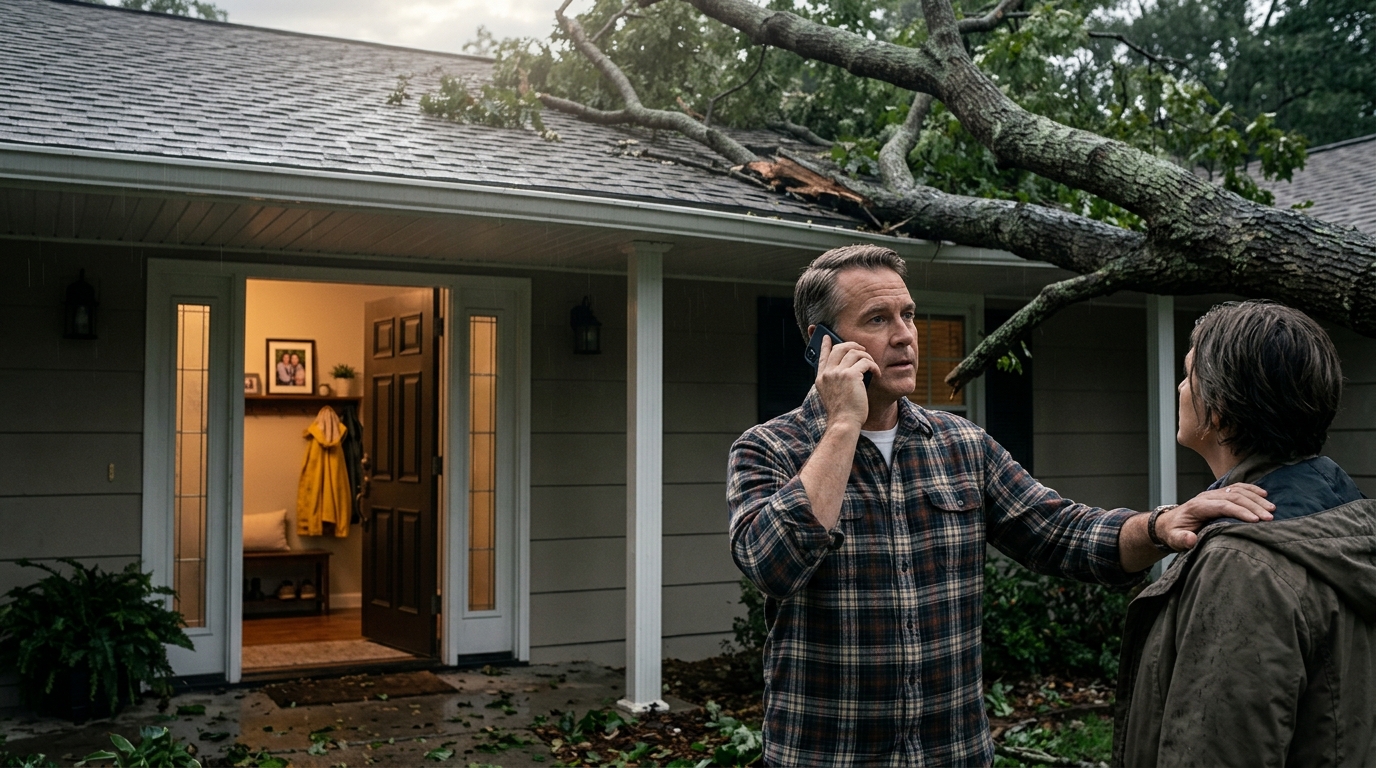
Call 911 immediately if you smell gas, see downed power lines, or if anyone is injured. If the structure is intact and there are no immediate life-safety hazards, call your homeowners insurance provider to start the claim, then contact a licensed, insured tree service for removal. This guide covers the exact order of operations, how to handle the insurance claim, and how to safely hire a professional crew.
Emergency Safety Protocols
When a tree falls on a roof, the first priority is human safety, not property. A tree that has landed on a structure is rarely done moving. Branches settle, the trunk rolls, and a roof that held the initial impact can give way an hour later. You must treat the area as unstable until a professional confirms otherwise.
Step 1: Evacuate and Secure the Perimeter
Get everyone out of the house and away from the tree. Leave through a door on the side opposite the tree. Keep people and pets away from the tree and from under the damaged part of the roof. Do not go into the attic, as the ceiling joists may be compromised. If the tree is resting on an intact roof and no one is hurt, you can return for essentials, but stay out of the rooms directly under the tree.
Step 2: Check for Gas and Power Hazards
Walk the outside of the house and look for three things: a gas smell, any wire down or pulled away from the house, and a ceiling or wall that is bowing. If you smell gas, leave and call 911 or the gas utility from outside. If any line is down, touching the tree, or pulled off the house, stay at least 10 feet away and call the utility or 911. A tree on lines is the utility's job, not yours.
Step 3: Document the Damage
Photograph everything before it is touched. Take wide and close shots of the tree on the house, the base of the tree, and the damage to the roof. The base of the tree is critical because rot at the base decides who pays. If the tree was already dead and rotting, your insurance may deny the claim. If it was healthy and fell due to wind, coverage is more likely. These photos are your evidence for the insurance adjuster.
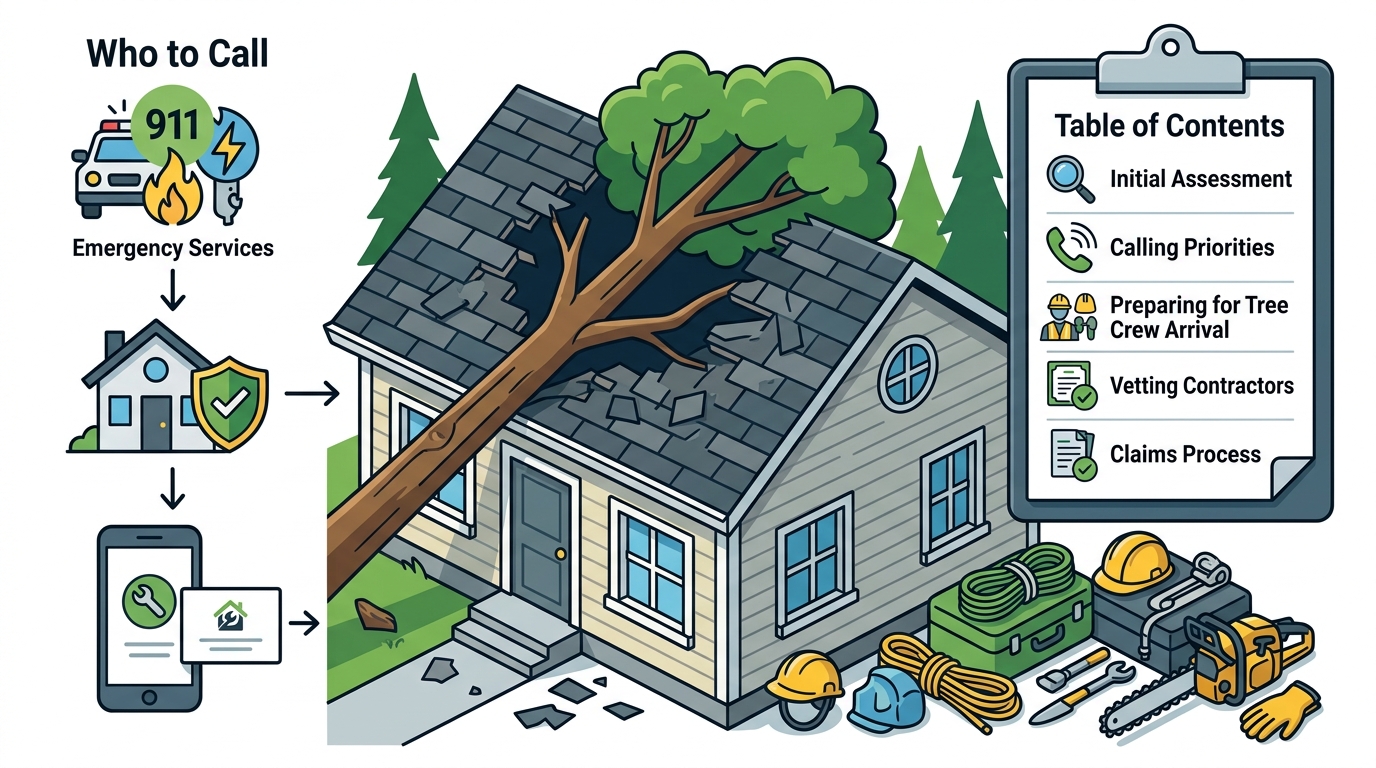
Insurance Claims Process
Homeowners insurance covers tree removal only if the tree fell on a covered structure, like your house, garage, or fence, or blocks your driveway. Then removal is typically covered up to $500 to $1,000 per tree, after your deductible. It does not cover removing a standing tree, a dead tree, or a fallen tree that hit nothing. The rule to remember is "only if it hit something."
Understanding Coverage Limits
Most standard policies cap tree and debris removal at $500 to $1,000 per tree, often with a $1,000 per-storm total. If the tree is large and the removal costs $3,000, you will pay the difference. The structure repair is covered under your dwelling coverage, which has a much higher limit. Your deductible applies to the entire claim, not just the tree removal. Check your policy for the exact wording on "debris removal" and "tree removal."
Filing the Claim
Call your insurer as soon as it is safe to do so. They will send an adjuster to inspect the damage. Do not let a tree service start cutting before the photos are taken or the insurer is called. The adjuster needs to see the tree in its original position to determine if it was a covered peril. If the tree is on a power line, the utility will clear the line, and you will only pay for the remains after the line is clear. Keep all receipts for tarping, removal, and roof repair to submit to your insurer.
Hiring the Right Crew
After the immediate hazards are addressed, you need to hire an insured crew for removal. Emergency work costs roughly 1.5 to 2 times the normal price, so if the tree hit nothing and is stable, call nobody tonight and line up a vetted company next week. If it is on the house, you need a crew with the right equipment and insurance.
Vetting the Company
Ask for a certificate of insurance sent by the insurer showing general liability and workers' compensation. General liability, commonly $1,000,000 per occurrence, covers damage to your house, fence, or car. Workers' compensation covers the crew if someone is hurt. Have the insurance agent send it to you directly by email. That one step defeats the most common trick, which is a photocopied certificate from a policy that lapsed last year. Check that both policy periods include the date of your job.
Getting a Written Quote
Get a written, itemized proposal from an in-person visit. It should list felling, chipping, haul-away, stump grinding, and cleanup separately. Pay no more than about a third up front. Walk away from door-knockers, cash-only crews, and anyone offering to top a tree. Topping is a destructive practice that causes decay and weak regrowth. A legitimate company will not offer to top a tree.
Cost Expectations
Emergency removal off a house typically runs $1,500 to $5,000. A tree on a house usually needs a crane, which adds $500 to $1,500, and an emergency crew, which is why the all-in figure is higher. A tree in the yard costs the same next week as tonight, minus the surcharge. Stump grinding is a separate $100 to $400 charge. Full removal with the roots dug out costs $300 to $1,000 or more.
| Situation | Call First | Who Pays | Typical Cost to You |
|---|---|---|---|
| Tree on your house or garage | 911 if gas or lines; then insurer | Your homeowners policy | Deductible plus removal above the $500 to $1,000 per tree cap |
| Tree in the yard, hit nothing | Tree service, next week | You | $200 to $500 for a medium tree |
| Neighbor's tree on your property | Your insurer | You, unless they knew it was hazardous | Your deductible |
| Tree on power lines | Utility or 911 | Utility clears the line | Only the remains after the line is clear |
Key Takeaways
- Call 911 if you smell gas, see downed power lines, or if anyone is injured.
- Photograph everything before it is touched, including the base of the tree.
- Homeowners insurance covers removal only if the tree hit a covered structure.
- Removal is typically covered up to $500 to $1,000 per tree, after your deductible.
- Emergency removal off a house typically runs $1,500 to $5,000.
- Ask for a certificate of insurance sent directly by the insurer.
- Get a written, itemized proposal from an in-person visit.
- Pay no more than about a third up front.
Frequently Asked Questions
Do I call 911 for a tree on my house?
Call 911 if anyone is hurt, you smell gas, a power line is down or touching the tree or the house, or part of the house has collapsed. If the tree is sitting on an intact roof, nobody is hurt, and there is no gas or line involved, you do not need 911. Call your utility if the service wire was pulled loose, then call your insurer.
Does insurance cover storm tree damage?
Homeowners insurance covers tree removal only if the tree fell on a covered structure, like your house, garage, or fence, or blocks your driveway. It does not cover removing a standing tree, a dead tree, or a fallen tree that hit nothing. The rule is "only if it hit something."
How much does emergency tree removal cost?
Emergency removal off a house typically runs $1,500 to $5,000. A tree on a house usually needs a crane, which adds $500 to $1,500, and an emergency crew, which is why the all-in figure is higher. A tree in the yard costs the same next week as tonight, minus the surcharge.
Who removes a tree on power lines?
The utility removes a tree on power lines. Stay at least 10 feet away and call the utility or 911. The utility clears the line, and you will only pay for the remains after the line is clear. Do not touch the tree or the lines.
How do I avoid tree removal scams after a storm?
Walk away from door-knockers, cash-only crews, and anyone offering to top a tree. Ask for a certificate of insurance sent directly by the insurer. Get a written, itemized proposal from an in-person visit. Pay no more than about a third up front. Check the company's license and credentials.
Should I leave the house after a tree falls on it?
Yes, at least until you have checked it from outside. A tree that lands on a roof is rarely done moving. Leave through a door on the side away from the tree, take pets, and keep everyone off the lawn under the canopy. Walk the outside and look for a gas smell, any wire down, and a ceiling or wall that is bowing.