

TreeProfessionals.com explains that most US states do not license tree work, making insurance and professional credentials the primary verification tools. A legitimate company provides a current certificate of insurance, a physical address, and verifiable ISA certification numbers. Checking these details takes about 10 minutes and protects you from uninsured risks.
The Licensing Landscape in the US
Tree removal and pruning are not licensed trades in most of the country, unlike plumbing or electrical work. This regulatory gap means that anyone with a pickup truck and a chainsaw can legally call themselves a tree service. In a handful of states and some cities, specific requirements exist, such as a general contractor license for jobs above a certain value or a pesticide applicator license for spraying. Your state contractor board website will tell you if these apply. Where no specific license exists, a city business license is not a qualification; it only means the business paid a fee to operate. The real vetting must focus on insurance and professional credentials.
Insurance as the Primary Safety Net
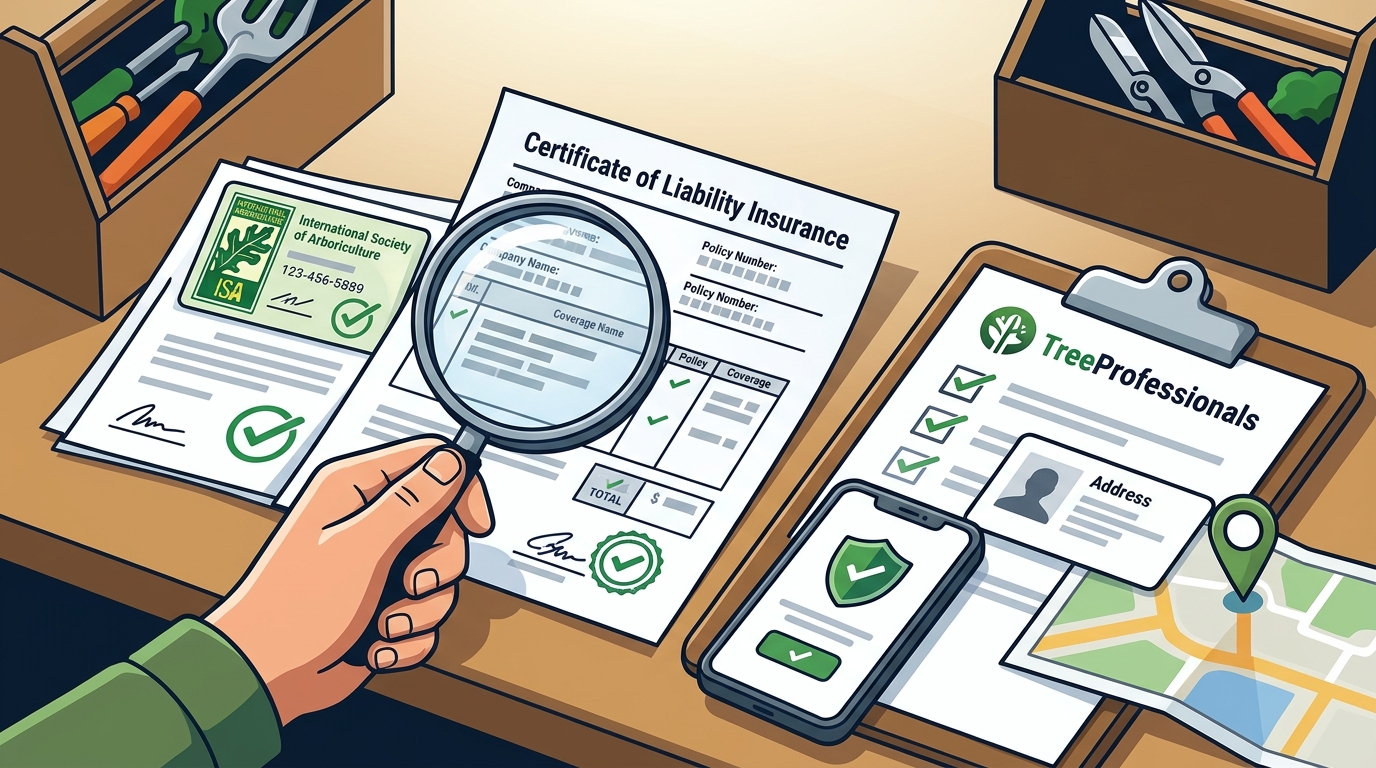
Because licensing is rare, insurance is the most critical check for any tree company. A legitimate business carries general liability insurance, commonly at $1,000,000 per occurrence, which covers damage to your house, fence, or car. They must also carry workers' compensation insurance to cover the crew if someone is injured on your property. To verify this, ask the company's insurance agent to send the certificate of insurance directly to you by email. This step defeats the common trick of using a photocopied certificate from a lapsed policy. Check that both policy periods include the date of your job. Honest companies hand this over without blinking because they are asked every week.
Professional Credentials and Certifications
While company licenses are often absent, individual professional credentials are verifiable and valuable. An ISA Certified Arborist is a trained individual who understands tree biology, risk, and treatment. You can verify an arborist's certification number in the public ISA directory. This credential indicates that the person has passed a rigorous exam and maintains continuing education. It is a strong signal of expertise, particularly for complex decisions like whether a tree can be saved or how risky it is. However, a company can have one certified arborist and many uncertified workers. Ask specifically who will be on your job and whether they hold the certification.
Physical Presence and Track Record
A legitimate tree company has a fixed physical address and a working local phone number. Scammers and fly-by-night crews often operate from a PO box or a cell phone with no local presence. Search the company name and address on a map to confirm they exist. Call the number to ensure it is answered by a human. Check that the name on the trucks matches the name on the quote. Additionally, ask for two references from similar recent jobs. Call them and read the one-star reviews online for patterns of complaints. A track record of completed work is a more reliable indicator of quality than any marketing claim.
Red Flags to Watch For
Several red flags indicate a company is not legitimate. Door-knockers who appear after a storm are a major warning sign. Cash-only crews who refuse to provide a written quote or accept a check are another. Anyone who offers to top a tree, which is a destructive pruning practice, lacks professional training. Pressure tactics, such as demanding a deposit before showing up, are also common with unscrupulous operators. If a company cannot provide a certificate of insurance, a written itemized quote, or a physical address, walk away. These are non-negotiable requirements for a safe and professional service.
Key Takeaways
- Most US states do not license tree work, so insurance is the primary verification tool.
- Request a certificate of insurance sent directly by the agent to verify general liability and workers' compensation.
- Verify ISA Certified Arborist credentials in the public directory to confirm individual expertise.
- Confirm the company has a physical address, local phone number, and matching truck branding.
- Ask for two references and read online reviews for patterns of complaints.
- Avoid door-knockers, cash-only crews, and anyone who offers to top a tree.
- Get a written, itemized quote from an in-person visit before hiring.
Frequently Asked Questions
Do tree companies need a license in most states?
In most states, no. Tree removal and pruning are not licensed trades. A few states and cities have specific requirements, but generally, insurance and credentials are the key checks.
How do I verify a tree company's insurance?
Ask the company's insurance agent to send a certificate of insurance directly to you by email. Check that the policy periods include your job date and that it covers general liability and workers' compensation.
What is an ISA Certified Arborist?
An ISA Certified Arborist is a professional who has passed a rigorous exam in tree biology and risk assessment. You can verify their certification number in the public ISA directory.
Is a city business license a qualification?
No. A city business license only means the business paid a fee to operate. It does not indicate skill, insurance, or safety practices.
Who should I call if a tree is near power lines?
Call your utility company. They are responsible for trimming trees near power lines. Do not attempt to trim branches near lines yourself.
What should a written quote include?
A written quote should list felling, chipping, haul-away, stump grinding, and cleanup separately. It should also include proof of insurance and a fixed price.
Find a Vetted Professional
Verifying a tree company's licenses and certifications is a short process that saves you from significant risk. Use the checks outlined above to ensure you are hiring a legitimate, insured, and qualified professional. TreeProfessionals.com provides a directory of listed tree care companies where you can browse by location and credentials. To plan your visit, find a professional in your area.