
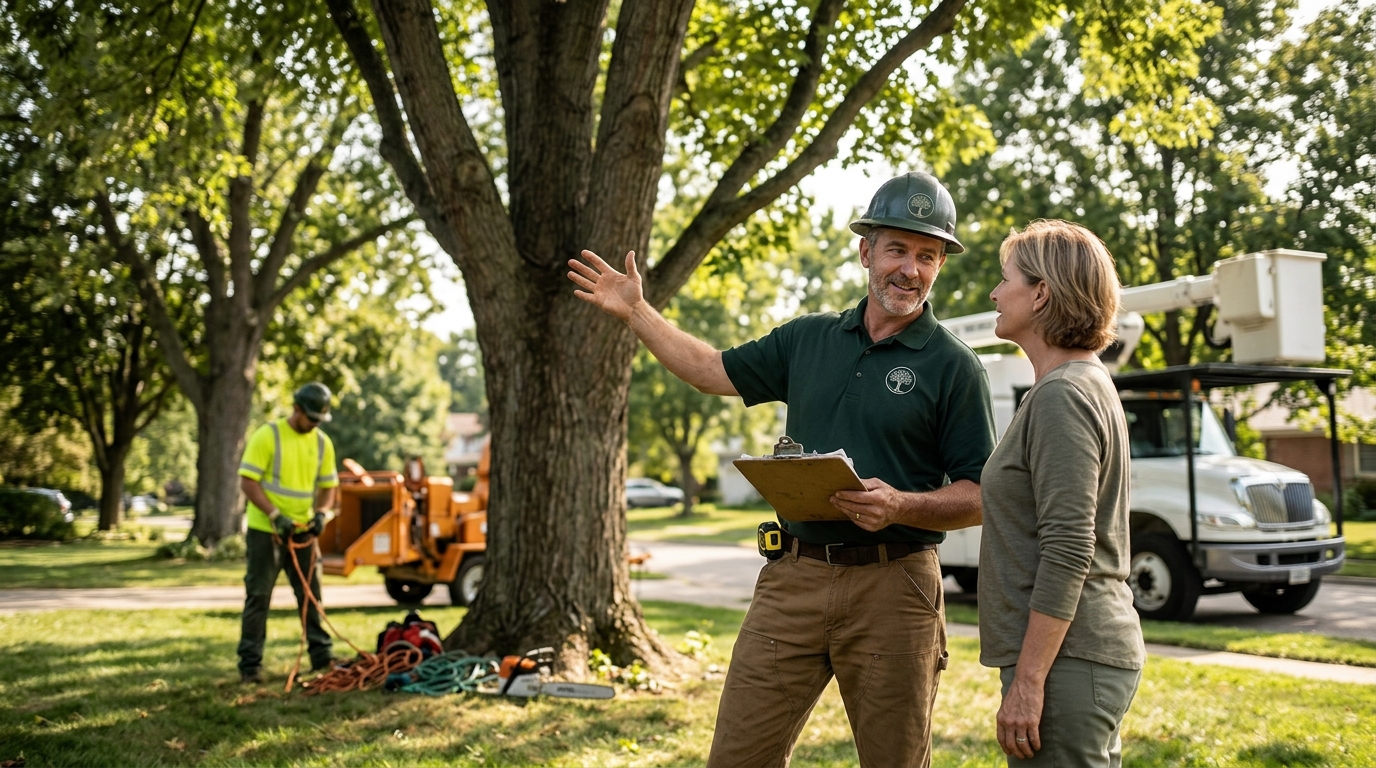
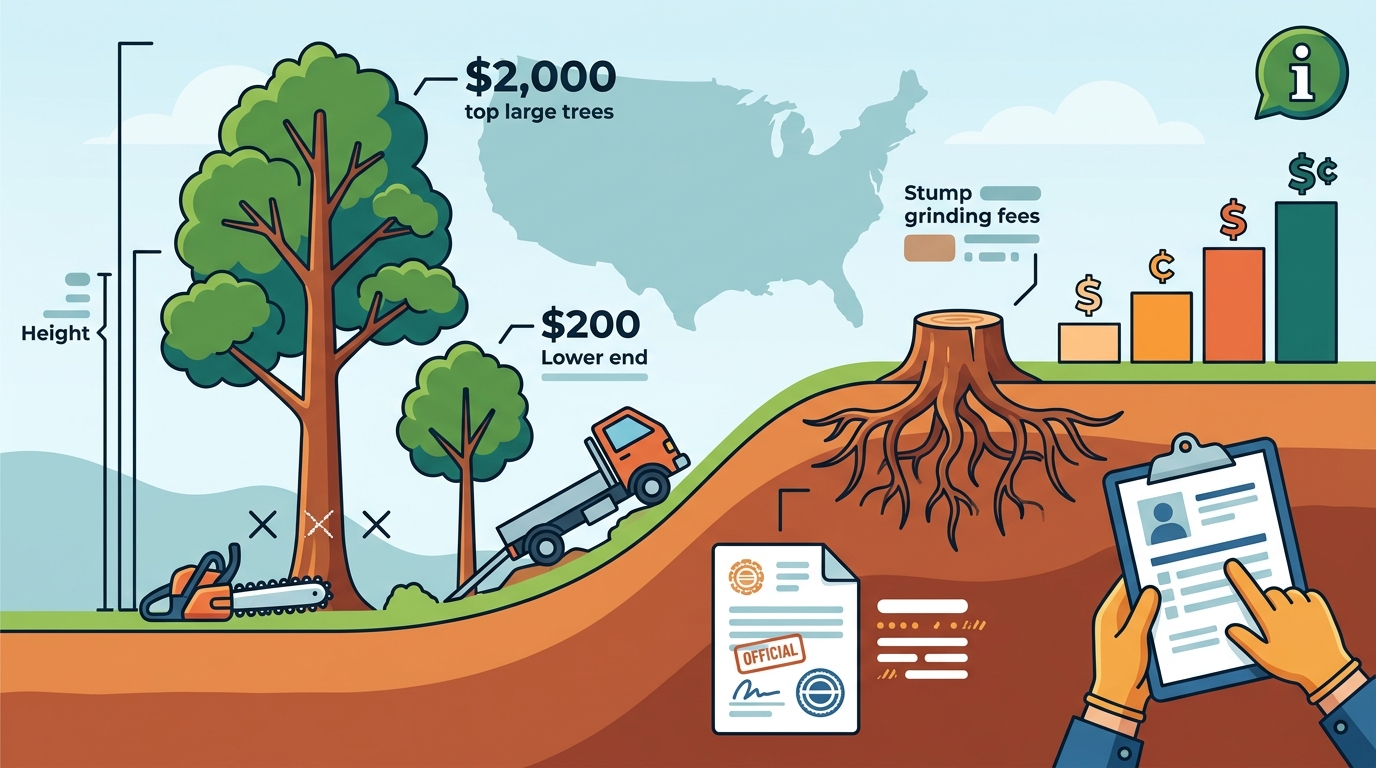
Tree removal costs between $200 and $2,000 in the US, depending mostly on height and access. This guide breaks down pricing by tree size, explains how accessibility and hazards affect your quote, covers permit requirements, and details separate stump grinding fees. TreeProfessionals.com provides these plain-English answers to help you budget accurately before hiring a professional.
Tree Size Categories
Height is the single biggest driver of tree removal cost. A tree removal service is a company that cuts a tree down and hauls it away, usually in sections, by an insured crew. The price you pay reflects the labor, equipment, and time required to safely dismantle the tree. Most quotes fall into four distinct size bands.
Small Trees (Under 30 Feet)
Small trees, such as dogwoods, crabapples, or young maples, typically cost between $200 and $500 to remove. These trees can often be felled in one piece and dropped to the ground. A crew of one or two workers can usually handle this job in half a day or less. The low cost reflects the minimal equipment needed, often just a chainsaw and a truck for debris.
Medium Trees (30 to 60 Feet)
Medium trees, including mature fruit trees, most ornamentals, and small pines, generally range from $500 to $1,000. These trees usually require a climber or a bucket truck to work safely from the top down. Branches are chipped on site, and the trunk is sectioned into manageable pieces. This is the most common size category for residential properties.
Tall Trees (60 to 80 Feet)
Tall trees, such as mature oaks, maples, pines, or ashes, cost between $800 and $1,500. Removing these trees involves a sectional dismantle with rigging. A full crew and a dump truck are required to handle the volume of wood. If the tree is near a structure, the cost leans toward the higher end of this range due to the precision required.
Very Large or Hazardous Trees (80+ Feet)
Very large trees or those in hazardous conditions can exceed $1,500, often reaching $3,000 or more. These jobs may require a crane or specialty rigging equipment. The extra cost covers the specialized machinery, a larger crew, and the increased insurance risk associated with working at extreme heights or in tight spaces.
Cost Factors & Accessibility
While height sets the baseline price, accessibility determines how much more you will pay. A tree removal cost is the total charge for cutting, chipping, and hauling a tree, which varies based on how easily a crew can reach the tree. If a bucket truck can drive right up to the trunk, the job is faster and cheaper. If the tree is in a tight backyard with no vehicle access, the crew must climb and lower every section by hand, which takes significantly longer.
Proximity to Structures
Trees located near houses, garages, or power lines command a premium. When a tree is close to a structure, the crew cannot simply drop sections to the ground. They must rig the wood and lower it slowly and carefully. This process is slower and requires more skilled labor, often adding 20% to 50% to the base price. The closer the tree is to the structure, the higher the risk and the higher the cost.
Yard Access and Terrain
Steep slopes, rocky ground, or dense undergrowth make it difficult to move equipment and debris. If a crew cannot drive a chipper or dump truck into the yard, they must carry wood out by hand or use a winch. This manual labor increases the time on site and raises the final invoice. Flat, open yards with clear paths to the street are the most cost-effective scenarios for tree removal.
Hazards & Risk Premiums
Hazardous conditions add a risk premium to any tree removal job. A hazardous tree is one that is dead, dying, leaning, or damaged in a way that makes it unstable. Removing a healthy, straight tree is a routine task. Removing a tree with a large dead limb, a hollow trunk, or a severe lean requires constant vigilance. The crew must monitor the tree's movement and be prepared for unexpected shifts.
Dead or Dying Trees
Dead trees are brittle and unpredictable. Branches may snap without warning, and the trunk may split along hidden decay lines. This unpredictability requires a slower, more cautious approach. Crews often use rigging to control the fall of each section, which takes more time than a standard felling. The cost reflects the higher liability and the specialized skills needed to manage the risk.
Storm Damage
Storm-damaged trees often present complex hazards. A tree may be split, leaning, or partially collapsed. If a tree has fallen on a house or other structure, emergency removal costs are significantly higher. Emergency removal with a crane can run $1,500 to $5,000. The urgency and the complexity of clearing debris from a damaged structure drive these higher prices. Homeowners should check their insurance policy to understand what is covered in these scenarios.
Permits & Local Regulations
Many cities and counties require a permit to remove a tree, especially if the tree is large or protected. A tree removal permit is a local government authorization that allows you to cut down a tree on your property. Permit requirements vary widely by jurisdiction. Some cities require permits for any tree over a certain trunk diameter, while others only regulate protected species or trees in public rights-of-way.
How to Check Permit Requirements
Before hiring a crew, check with your local municipal office or planning department. Ask specifically about the rules for your address. Some areas require a permit for trunks over 6 to 12 inches in diameter. Others may have lists of protected species that cannot be removed without a special variance. Failing to obtain a required permit can result in fines, so it is worth the time to verify local rules.
HOA and Neighborhood Rules
If you live in a community with a Homeowners Association, check the covenants and conditions. Many HOAs have rules about tree removal, particularly for mature or ornamental trees. You may need written approval from the HOA board before proceeding. Ignoring these rules can lead to disputes with neighbors or the association, so review your community guidelines early in the process.
Stump Removal Pricing
Stump work is almost never included in the base tree removal price. Stump grinding is a process that chips the stump down to 6 to 12 inches below ground level, leaving the roots to rot naturally. Stump removal is a process that digs out the entire stump and root ball, leaving a hole that must be filled. Most homeowners choose grinding because it is faster and cheaper.
Stump Grinding Costs
Stump grinding typically costs $100 to $400 per stump. Most professionals charge $2 to $5 per inch of stump diameter, with a minimum charge of $100 to $150. A 20-inch stump might cost $100 to $150, while a 40-inch stump could cost $150 to $250. If you have multiple stumps on the same visit, the cost per stump often decreases. The ground-down area is left as wood chips, which can be used as mulch or hauled away for an extra fee.
Full Stump Removal Costs
Full stump removal, which involves digging out the roots, costs $300 to $1,000 or more. This option is chosen when you plan to plant a new tree in the same spot or when the root system is causing problems with foundations or sidewalks. The cost depends on the depth of the roots and the difficulty of digging them out. It leaves a large hole that must be backfilled with soil, which may add to the total cost.
| Tree Size | Typical Removal Cost | Stump Grinding Cost | Key Cost Drivers |
|---|---|---|---|
| Small (Under 30 ft) | $200 - $500 | $100 - $150 | One-piece felling, minimal equipment |
| Medium (30 - 60 ft) | $500 - $1,000 | $150 - $250 | Climber or bucket truck, on-site chipping |
| Very Large (80+ ft) | $1,500 - $3,000+ | $300 - $400+ | Crane or specialty rigging, high risk |
Key Takeaways
- Tree removal costs range from $200 to $2,000, with height being the primary price driver.
- Stump grinding is a separate charge, typically costing $100 to $400 per stump.
- Accessibility and proximity to structures can add 20% to 50% to the base price.
- Hazardous conditions, such as dead or storm-damaged trees, increase costs due to higher risk.
- Many cities require permits for tree removal, especially for large or protected trees.
- Homeowners insurance typically covers removal only if the tree fell on a covered structure.
- Always get a written, itemized quote from a vetted, insured company.
- Check local permit requirements and HOA rules before scheduling work.
Frequently Asked Questions
How much does it cost to remove a small tree?
Removing a small tree under 30 feet typically costs between $200 and $500. This price usually includes cutting the tree down, chipping the branches, and hauling the debris away. Stump grinding is an additional cost, usually ranging from $100 to $150 for a small stump.
Is stump grinding included in the tree removal price?
No, stump grinding is almost always a separate charge. Most tree removal quotes cover the tree itself, but you must request stump grinding explicitly. It typically costs $100 to $400 per stump, depending on the diameter and accessibility.
Do I need a permit to remove a tree on my property?
It depends on your local jurisdiction. Many cities require a permit for trees with trunks over a certain diameter, such as 6 to 12 inches. Some areas also protect specific species. Check with your local municipal office to confirm the rules for your address before hiring a crew.
How much does it cost to remove a tree near a house?
Trees near houses cost more due to the precision required. A medium tree near a structure might cost $800 to $1,500 instead of the standard $500 to $1,000. The crew must rig and lower sections carefully to avoid damaging the roof or siding, which takes more time and skill.
Does homeowners insurance cover tree removal?
Homeowners insurance typically covers tree removal only if the tree fell on a covered structure, like your house or garage. It does not cover removing a standing tree or a fallen tree that hit nothing. If a tree hits your house, removal is usually covered up to $500 to $1,000 per tree, after your deductible.
What is the cheapest time of year to remove a tree?
Late winter, during the dormant season, is usually the cheapest time to schedule tree removal. Trees have no leaves, which makes it easier for crews to see the structure and work efficiently. Demand is also lower in winter, so companies may offer better rates. Avoid scheduling work during peak storm seasons when demand is high.
Conclusion
Understanding the factors that drive tree removal costs helps you budget accurately and avoid surprises. Height, accessibility, hazards, permits, and stump work all play a role in the final price. By knowing what to expect, you can make informed decisions about which trees to remove and how to manage the process. TreeProfessionals.com provides these plain-English answers to help you navigate the practical side of tree care. To find a local professional for your specific situation, browse our directory of tree care companies.